Table of Contents
Personal Statement: With AI Training and Voice Over…
A sector that I currently work in, I personally have noticed a change. As models get more sophisticated the verification has been falling down and the result is that I am often offered assignments where I have to do Uk English evaluation too rather than just do voice work.
Sometimes the systems that have developed just don’t work and I have been compelled by the system to put answers that I know are wrong just to get to the next stage. The reality is that I leave – I don’t need that kind of cultish cognitive dissonance. The clients who hire me value my candidness and clarity, not how well I submit to their annotation system regardless of what the best answer is.
Ok rant over !
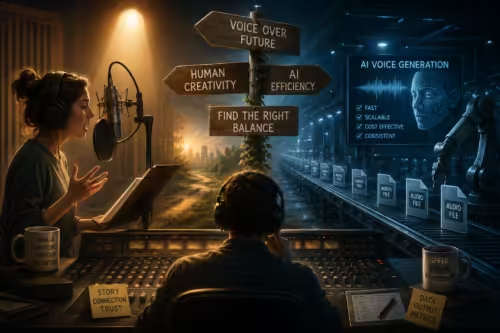
A strange thing has happened in AI Training and voice over. A few years ago, artificial intelligence was something sitting on the horizon. Interesting, slightly worrying, but not really affecting the day-to-day work of voice actors. Now it is here.
Many of us have already worked on AI training projects without the wider world really understanding what that involves. Behind every realistic synthetic voice there are still humans: recording, reviewing, correcting pronunciation, checking emotion, and making sure the final result actually sounds natural.
And that last part is harder than people imagine. Modern AI voice platforms have moved a long way beyond the robotic text-to-speech systems many people remember. Today’s systems can produce remarkably realistic voices with control over pace, emphasis and emotional style.
But a voice is not just words converted into sound. Take the simple phrase:
“Really? You did that?”
Depending on the delivery, that could mean surprise, anger, admiration, disbelief or humour. Humans understand that instantly. Teaching machines those differences is where much of the current work is happening.
AI voice technology is becoming increasingly useful where speed, consistency and scale matter: training materials, corporate content, explainer videos, localisation and projects requiring large volumes of audio.
Human performers still have an important place…
Advertising, storytelling, character work and projects where trust and personality matter rely on more than simply producing accurate speech.
There is also a growing discussion around ethics. Voice cloning raises important questions about permission, ownership and compensation. The best uses of this technology should involve consent and clear agreements between companies and performers. The irony is that AI voice technology still relies heavily on human voices and human judgement. For voice actors, this creates a strange situation. We are sometimes helping to build the very technology that is changing our industry.
Humans Beings are Lazy and Profit Driven
Is AI replacing voice over? Some parts, almost certainly. But it is also creating new roles around AI training and voice training, English evaluation, quality control and helping machines understand the subtle things humans do naturally.
The future may not simply be human versus machine. With discussions around cognitive load. A human is not going to try hard to fix something a bot can do in seconds. The trouble is that the human may lose a bit of the apparatus that makes them strive and the fear is that we become more insipid shadows of ourselves. Of course you could flip this on its head and suggest that the human would still be striving, just on a different level.

#MachineLearning
#HumanInTheLoop
#VoiceTechnology
#DataAnnotation
#DigitalTransformation
#FutureOfWork
Information for Nerds – How Did We Get Here So Fast?
The strange thing about the current AI revolution in AI Training and Voice Over is how quickly it seemed to arrive. For decades computers could process information, but they did not really communicate like humans. Then, within a few years, everything changed.
2020 – Bigger Models, Better Predictions
Large language models began showing that if you trained systems on enough information, they could produce surprisingly natural responses. They were not simply retrieving answers. They were learning patterns in language.
2022 – AI Enters the Mainstream
The release of consumer AI chat systems changed public awareness almost overnight. Suddenly millions of people were interacting with AI directly rather than reading about it as something happening in a research lab.
2023 – Voice Becomes Realistic
AI voice technology made huge improvements. The old robotic text-to-speech voices started disappearing and were replaced by systems capable of producing realistic pacing, tone and emotion. This is also when many voice actors started finding themselves involved in a new kind of work: recording, evaluating and training the systems themselves.
2024–2025 – The Evaluation Problem
As AI became more capable, a new challenge appeared. Generating an answer was no longer the difficult part. Determining whether that answer was actually correct, natural or useful became the problem. This created demand for human reviewers, language specialists and voice professionals who could judge quality.
Today – The Human Layer
The surprising thing about modern AI is how much human involvement still exists behind the scenes. Every natural conversation, every believable voice and every small improvement depends somewhere on human judgement. The machine can generate. But humans still decide whether it actually makes sense.
With AI Training and Voice Over one thing is clear, the future will completely unpredictable…