Table of Contents
Gurus have been giving medical narration a bad name in the current era – scams, cognitive dissonance, coercive cults. There is great power in the spoken word but it can be a positive force if managed properly.
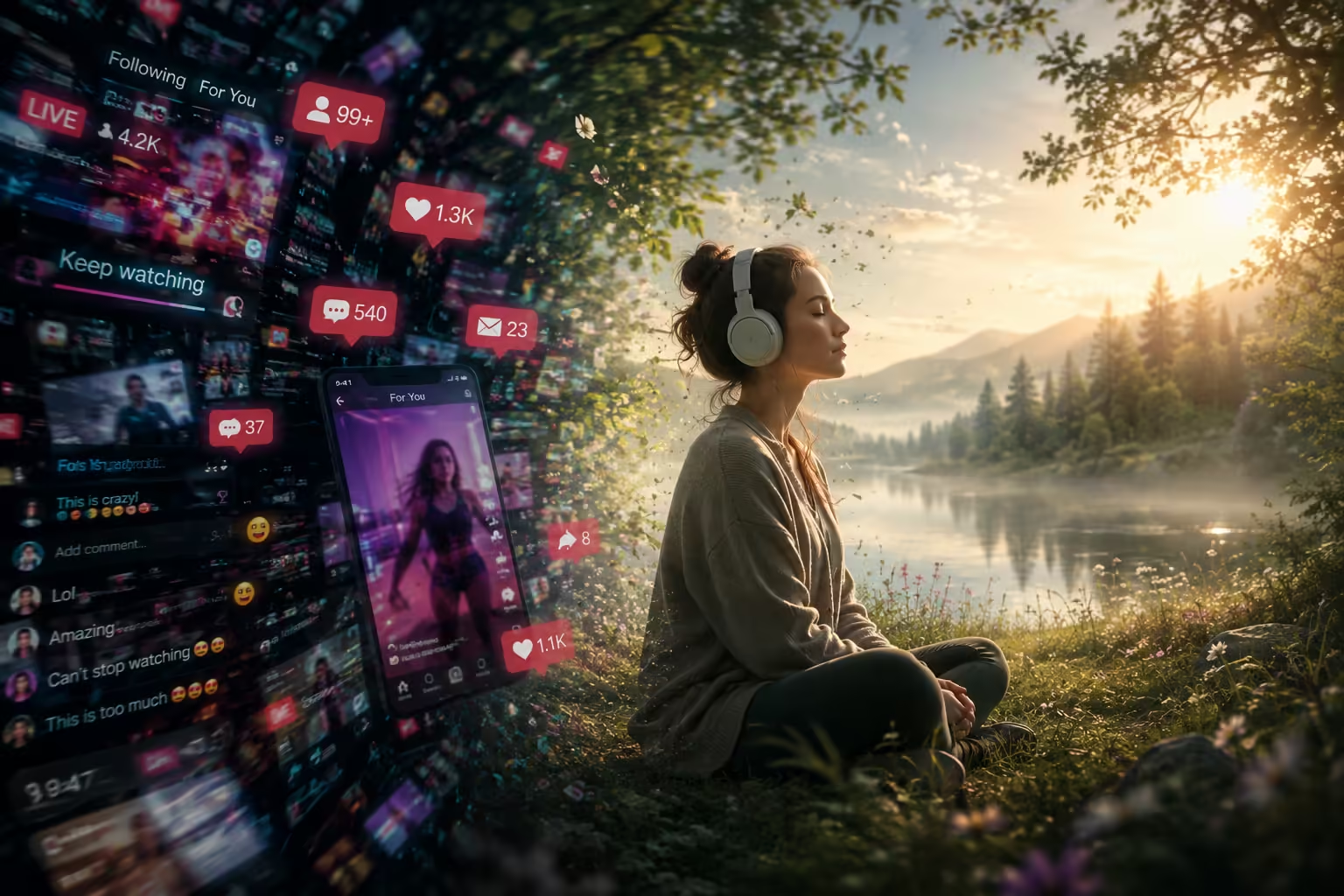
The battle for attention that is being waged my mega-corps today, we flick to this then that, then back again. One little hit after the next in an endless loop shrinking our brains to a 5 second sound byte. People are becoming wise to this cynical trend and as evidenced by the meteoric rise of meditation narration in podcasts, pathworking, breathwork and wellness.
At first glance, meditation narration seems almost out of place in the modern world.
We live in an age of short-form content. Social media platforms compete relentlessly for our attention, rewarding rapid engagement, endless novelty and constant stimulation. Many of us now consume information in snippets measured in seconds rather than minutes.
Yet, against this backdrop, guided meditation, mindfulness apps and long-form narration continue to grow in popularity.
The answer may lie in a curious paradox
The same digital environment that encourages fragmented attention may also be creating a growing demand for experiences that help restore it.
For decades, meditation was often viewed as something that belonged on the cultural fringe. Images of incense, chanting and spiritual retreats dominated the public imagination. Today, however, meditation has quietly found a place in healthcare, psychology, corporate wellbeing programmes, sleep applications and digital therapeutics. It has become less about escaping reality and more about learning to navigate it.
This change reflects something deeper than a shift in fashion. Attention has become one of our most valuable resources.
Every notification, recommendation algorithm and autoplay feature competes for a share of it. Businesses understand its value because attention is the gateway to decision-making, learning and behaviour. In many respects, the modern economy is built upon attracting, measuring and retaining attention.
Meditation narration approaches the same resource from the opposite direction.
Rather than constantly introducing novelty, it deliberately reduces it. Rather than encouraging the listener to jump between competing stimuli, it invites sustained focus on a single voice, a single breath or a single train of thought. The objective is not to stimulate the mind but to settle it.
Perhaps this explains its growing success.
The greater the cognitive noise surrounding us, the greater the value of experiences that offer a different pace. In economic terms, scarcity often creates value. In psychological terms, sustained attention may be becoming increasingly scarce.
From my own narrator’s perspective, this presents an interesting challenge.
Meditation narration is not simply about reading slowly. Every pause, emphasis and change in pacing influences the listener’s experience. Trust, clarity and consistency become just as important as vocal tone. The narrator is not trying to entertain or persuade but to create the conditions in which the listener can remain engaged with their own thoughts.
As healthcare and wellbeing continue to overlap with digital technology, meditation narration is becoming increasingly significant. Whether supporting stress reduction, patient wellbeing, sleep programmes or mindfulness applications, its purpose extends beyond communication alone.
Ironically, in an age increasingly defined by distraction, one of the most valuable things a voice can offer may simply be the opportunity to pay attention again.
❦ Medical Narration ❦ The Evolution of Medical Narration ❦
❦ ❦ ❦
Forest Pathworking
I am still building a canon of material in this area and it something that has a personal relevance for me to explore. I can build creative pathworking clips or work from the script supplied. I have included a short demo below of some of my pathworking material. Feel free to check it out an extract of this one – ‘Forest Pathworking’.

❦ ❦ ❦