Table of Contents
The Star rendition by Eric Fisher. Delivered by Payhip
The Symbolism of The Star
The Star is often regarded as one of the most hopeful and uplifting cards in the Tarot. Appearing after the upheaval of the Tower, it represents a moment of renewal, healing, and spiritual guidance. Where the Tower tears down what can no longer stand, the Star offers the first glimpse of light after the storm.
The central theme of the card is inspiration. The star itself acts as a beacon, suggesting that even when the path ahead is uncertain, there remains a guiding principle, inner truth, or higher aspiration capable of illuminating the way forward. It is a symbol of faith, not necessarily in a religious sense, but faith in possibility itself.
Water frequently plays an important role in depictions of The Star. It represents the flow of life, emotion, intuition, and the unconscious mind. The pouring of water can be seen as an act of continual renewal, suggesting that spiritual wisdom is not something to be possessed but something that flows through us and nourishes both the inner and outer worlds.
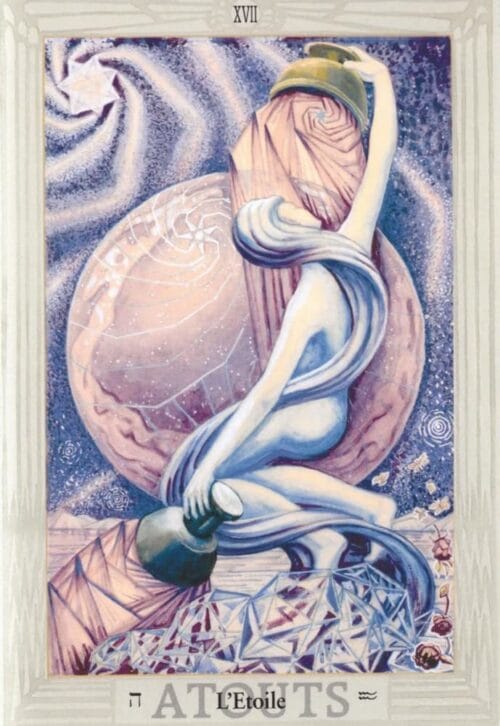
In the Crowley Thoth tradition, The Star takes on an especially cosmic quality. The imagery is rich with references to universal forces, divine energy, and the interconnectedness of all things. Rather than simply offering comfort, the card invites the seeker to recognise their place within a larger pattern. Hope emerges not from wishful thinking but from alignment with deeper currents of existence.
The naked figure often found within the card’s imagery symbolises truth, openness, and authenticity. Nothing is hidden. There is no armour, no disguise, no need for pretence. The card suggests that genuine inspiration arises when we are willing to encounter ourselves honestly.
At its heart, The Star is a reminder that periods of darkness do not last forever. It speaks of guidance, creativity, healing, and the quiet certainty that even when we cannot yet see the destination, the light to navigate by remains present.
For many readers, The Star is not merely a card of hope. It is a card of rediscovery—of finding one’s own light again after believing it had been lost.
A short history of the Crowley Thoth Deck
The Crowley Thoth Tarot is one of the most influential and visually striking Tarot decks of the twentieth century. Created through the collaboration of the English occultist and writer Aleister Crowley and the artist Lady Frieda Harris, the deck combines traditional Tarot symbolism with astrology, Kabbalah, alchemy, mythology, and Crowley’s own esoteric philosophy.
Work on the deck began in 1938. Originally intended as a relatively straightforward illustration project, the collaboration soon grew into something far more ambitious. Crowley provided detailed symbolic instructions while Harris repeatedly revised and refined the artwork, often producing multiple versions of individual cards. The project ultimately occupied the pair for almost five years.
The resulting images differed significantly from many earlier Tarot decks. While retaining the familiar structure of the Major and Minor Arcana, the Thoth deck introduced vibrant colours, complex geometric forms, and a wealth of symbolic references drawn from numerous mystical traditions. Several card names were altered, including Justice becoming Adjustment and Judgment becoming The Aeon, reflecting Crowley’s interpretation of occult philosophy.
Although the artwork was completed during the early 1940s, the deck was not widely published during Crowley’s lifetime. Following his death in 1947, interest in his writings and teachings continued to grow. The first widely available editions of the Thoth Tarot appeared in the late 1960s and early 1970s, bringing the deck to a much larger audience.
Today, the Thoth Tarot remains one of the most respected and studied Tarot decks in the world. Admirers praise its depth, symbolism, and artistic beauty, while students often find that its layered imagery rewards years of exploration. Whether approached as a tool for divination, meditation, personal reflection, or the study of Western esoteric traditions, the deck continues to inspire seekers more than eighty years after its creation.
The Star in the Thoth Tradition
While The Star has existed in Tarot for centuries, Crowley’s interpretation was heavily influenced by the spiritual and philosophical ideas he developed during the early twentieth century. He associated the card with the zodiac sign of Aquarius, the Water Bearer, linking it to ideas of renewal, inspiration, universal consciousness, and the free flow of spiritual energy.
In the Thoth deck, the card is numbered XVII and is connected to the Hebrew letter Tzaddi. However, Crowley introduced one of his most controversial ideas concerning the Tarot: the notion that “Tzaddi is not the Star.” This cryptic statement, derived from his mystical experiences and writings, led him to reconsider some of the traditional correspondences between the cards. It remains a topic of debate among students of the Thoth system to this day.
The artwork by Lady Frieda Harris is also unique. Unlike many earlier Tarot decks that depict a woman pouring water beneath a single prominent star, Harris created a vast cosmic scene filled with flowing forms, celestial symbolism, and radiant energy. The figure is less a person standing beside a pool and more an embodiment of natural and cosmic forces themselves.
Crowley referred to the central figure as a manifestation of celestial energy, connected to the Egyptian goddess Nuit, a divine figure representing the infinite star-filled heavens. This reflects one of the key themes of Crowley’s philosophy: that the individual is not separate from the universe but an expression of it.
The seven-pointed star that appears prominently in the card is particularly significant. Crowley called it the Star of Babalon, a symbol associated with spiritual liberation, mystical attainment, and the divine feminine within his magical system. This is one of the major ways the Thoth Star differs from more conventional Tarot interpretations.
Why the Card Feels Different
Many traditional decks present The Star as a gentle card of hope after hardship. The Thoth version still contains that meaning, but it feels larger in scale. Rather than saying:
“Things will get better.”
The Thoth Star is closer to:
“You are part of something vast, living, and interconnected. Align yourself with that current.”
That cosmic perspective is one reason the card has fascinated occultists, Tarot readers, and artists for decades. It is not merely about personal optimism. It is about inspiration flowing from a source that appears almost universal.