
Table of Contents
Want to earn 34% more? I I have just been reading Upwork’s Future workforce Index 2026 which I see is freely available. You might call this Part 2. Being of a geekish tendency I have saturated myself with AI knowledge and have been offered a lot of AI related annotation work. Despite a draw full of paper qualifications, my best qualification in the global marketplace still holds solid – being native born Uk English.
These work offers bring a little sigh from me. Current state of play from the ground up is that these jobs tend to expect you do unpaid training with systems that are still in Beta. The result – a lot of heartbreak.
Reflecting on the claim in the Upwork report which states ‘earn 34% more per hour‘ than those not incorporating AI, I think it is reasonable. For freelancers it is brutal out there. Without an edge you get almost nothing worth doing and keeping that edge can be like dancing on the head of a pin.
So returning to the key question how does someone out there leverage AI to earn 34% more, a little digging revealed a few things…
I noticed something interesting. The report is largely written from the top down. Organisations describe becoming more productive, employees describe using AI tools, and businesses report improved efficiency. From that altitude the picture looks encouraging.
The view from the ground is rather different. Many freelancers first encounter AI not as a productivity tool but as unpaid labour. They are asked to correct transcripts, rank responses, evaluate voices, annotate conversations and identify subtle errors so that the next generation of AI systems becomes more capable. It is essential work, but it is rarely glamorous and not always generously rewarded.
The freelancers who genuinely earn 34% more are not simply asking ChatGPT to write an email. They are becoming fluent in the entire AI ecosystem. They understand prompting, model evaluation, data quality, synthetic speech, human feedback, transcription workflows and where human judgement still adds value. In other words, they are learning how AI works rather than merely consuming its output.
Ironically, this may be where the real opportunity lies….
For someone working in audio, that can mean using AI to remove noise from recordings, speed up editing, organise scripts, research terminology, generate pronunciation guides, translate drafts or produce rough cuts that would previously have taken hours. The final product is still very much human, but the journey to get there becomes considerably shorter.
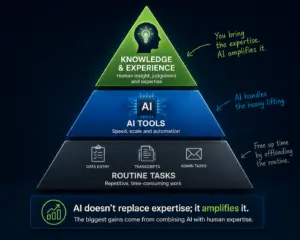
That, I suspect, is where the ‘earn 34% more’ comes from. AI rarely replaces expertise. More often it amplifies it. A skilled narrator equipped with AI can often produce more work in less time than a skilled narrator without it. Likewise, a researcher who understands AI tools can investigate topics more quickly, and a programmer who knows how to interrogate an AI assistant can spend more time solving problems than writing boilerplate.
From where I stand, the lesson is perhaps a little different from the headline. AI itself isn’t the edge. Understanding AI is the edge.
Those are two very different things. The reports tell us that AI is changing work. From the freelancer’s chair, I would add one more observation: those willing to understand the machinery behind the curtain may find opportunities that remain invisible to everyone else.
Information for Nerds – Who Is Nailing AI Right Now? –
Earn 34% more? – If the Upwork statistic is broadly correct, who is actually capturing that extra value?
From what I’ve observed, it isn’t necessarily the people producing the AI models. It’s the people sitting one layer above them, combining domain expertise with AI to produce more valuable work.
Some examples include:
- Software developers using AI as a coding partner rather than a replacement.
- Designers generating concepts rapidly before applying their own artistic judgement.
- Medical and legal professionals using AI to accelerate research while relying on human expertise for decisions.
- Voice-over artists speeding up editing, script preparation and pronunciation research while keeping the actual performance distinctly human.
- Writers and marketers using AI to generate ideas, outlines and research before applying their own experience and voice.
- Small business owners automating repetitive administration so they can spend more time serving customers.
Notice the pattern?
The people appearing to benefit most are not simply pressing a button and accepting the first answer. They already possess valuable knowledge. AI allows them to apply that knowledge faster and across more work.
In other words, AI seems to reward people who already know what “good” looks like.
Perhaps the biggest surprise is that many of the people helping build these systems—annotators, evaluators and quality reviewers—are often among the least visible. Their work quietly improves the models that everyone else eventually benefits from.
As someone who’s spent time evaluating AI-generated speech and language, I’d argue that human judgement remains one of the most valuable components in the entire pipeline. The irony is that the better the AI becomes, the less visible that human contribution often appears.
Final note….. every day is a school day and this topic is far from exhausted…